
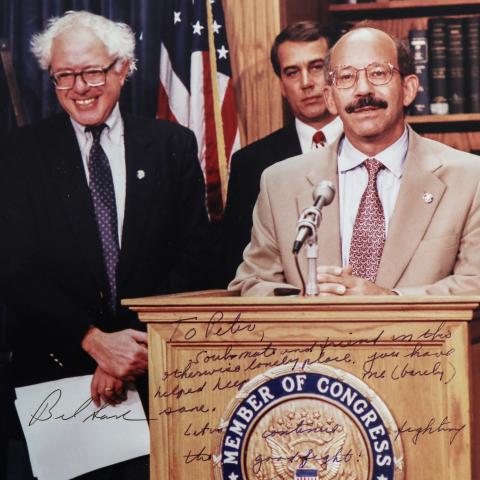
Service Records: The Legacy of Congressman Peter DeFazio in Special Collections
Documenting his 36 years representing Oregon's 4th Congressional District and more, the papers of Peter A. DeFazio—the renown "Tiger of the House"—are now available for public access in our Special Collections
The University of Oregon Libraries is pleased to announce the public opening of the Peter A. DeFazio papers. With archival processing now completed, the long-serving congressman’s historic documents are freely available to academic researchers, students, journalists, legal professionals, legislative advocates and the public community.
The longest-serving member of Congress in our state’s history, DeFazio represented Oregon's 4th Congressional District from 1987 to 2023. A member of the Democratic Party, he served as Chair of the House Transportation and Infrastructure Committee from 2019-2023. Previously DeFazio was the ranking member on the House Natural Resources Committee, where he focused on policies including energy, federal lands, oceans and fisheries, and Native American issues.
Co-founder of the Congressional Progressive Caucus, he was outspoken and tenacious in his advocacy for transportation safety, consumer protections and environmental preservation, earning him the nickname “Tiger of the House.”
“We are grateful to Peter for his generosity and foresight in donating this collection to UO, where it can be cared for and used by both the university community and researchers around the world,” said Vice Provost and University Librarian Alicia Salaz.
For DeFazio, it’s the culmination of a long and meticulous process to curate the record of his career in public service and ensure that it will remain accessible for future generations.
“I attended graduate school at the University of Oregon and the work I did for the 4th District pertains to the university and the surrounding area,” DeFazio said. “It seemed very appropriate to have the archives located here.”
The DeFazio papers are the largest collection held in the library's Special Collections and University Archives (SCUA). To help researchers navigate the vast resource, archivists have prepared a detailed collection guide and finding aid and arranged the materials in seven series:
- Legislative affairs
- District issues
- Press and public relations
- Office management files
- Campaign materials
- Personal papers
- Peter A. DeFazio congressional website
The collection is open to the public but must be used in the SCUA Reading Room in Knight Library. Patrons are encouraged to contact SCUA in advance of their visit.
Explore Collection Guide and Finding Aid
What's in the collection?
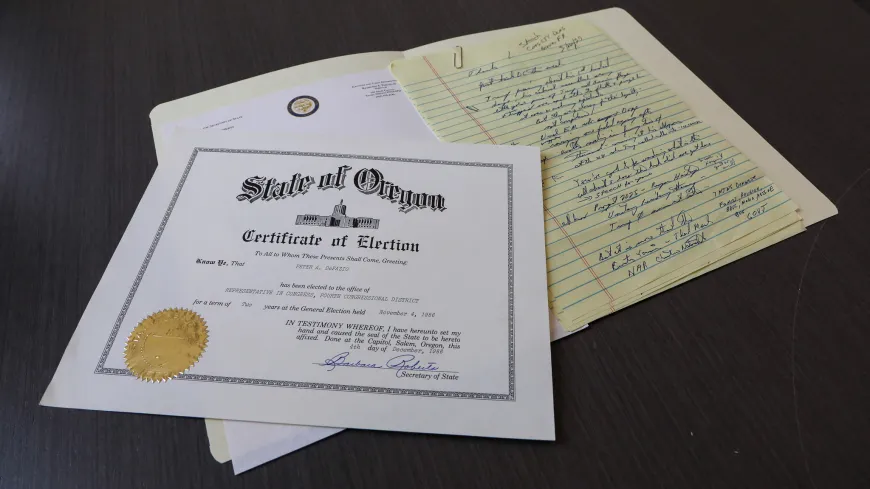
Documenting DeFazio’s legislative and political career over the course of his 36-year tenure as U.S. Representative for Oregon's 4th Congressional District, the papers are now permanently held in our SCUA repository.
The collection encompasses correspondence, copies of legislation, op-eds, press releases, newspaper clippings, photographs and office records. Additional materials predating DeFazio’s tenure in Congress are also preserved, including documentation of his formative political work in Lane County.
In an archival context, “papers” often means more than just paper documents.
Patrons can also access born-digital files dating back to when DeFazio acquired a personal computer to help with tasks like list-keeping and printing mailing labels for his first congressional primary race. Pacing technology into the twenty-first century, the collection closes with an archival crawl in 2022 of DeFazio's congressional website, shortly before he retired.
The Libraries also recorded a series of oral history interviews with DeFazio and three of his colleagues, providing additional insights and context for the collection materials.

Accessioning and Proccesing the Collection
Various laws, rules and customs govern the records of Congress and members’ papers. While the National Archives and Records Administration (NARA) collects and preserves some of the materials, most are considered the members’ personal property. Although some representatives, like DeFazio, choose to donate their papers to an archival repository, there is no legal requirement to preserve or make them available to researchers.
A meticulous saver of both official documents and personal ephemera, DeFazio began planning for his donation long before he left office.
“I met with the head librarian pretty early on, around 2008 to figure out what we needed to do,” he said. “We did some fundraising with UO Libraries and were able to hire an archivist starting the year I retired, 2023. It’s just coming to fruition now.”
In 2010, Manuscripts Curator Linda Long visited the suburban Maryland storage facility where copious materials from DeFazio’s office had been placed over the years. She offered professional guidance about which records could be recycled or discarded and which should be retained for future archiving. In an informal sense, curation of the collection began here—though much work remained to be done when the materials were eventually transferred to Knight Library in Eugene.
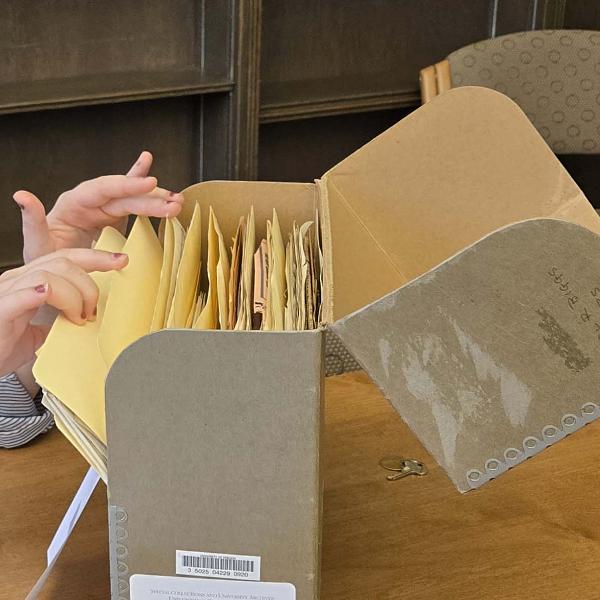
Today, the DeFazio papers are the largest collection held by SCUA. The physical media are housed in 384 containers occupying 480 linear feet of storage space. The collection also includes 468 gigabytes of digital files and archived website content.
The work to prepare this substantial trove has taken three years and contributions from many individuals, facilitated in part by generous financial support from the Coquille Indian Tribe. Professional archivists have arranged the collection in ways that both facilitate access for researchers and preserve the integrity of the original order of the documents, to demonstrate how DeFazio and his team used the materials as part of their own working processes.
“I’m grateful to the many people who worked as part of a team to accomplish this monumental task, from those who facilitated the transfer of the collection into storage, to SCUA staff who physically organized the collection into hundreds of boxes and thousands of folders,” said Sammie Morris, the Giustina Director of SCUA.
“Care was taken to review the collection to maintain adherence with privacy laws, and archivists worked tirelessly to inventory and describe the contents of the collection so that future researchers can easily identify which boxes to consult on their research topics. The work to preserve the digital and audio-visual parts of the collection requires specialized knowledge and—due to the rapid technological obsolescence of digital and audio-visual formats—this work is never truly completed.”
Peter DeFazio Research Award
The UO Libraries administers an annual research award especially for people interested in conducting in-depth research in the DeFazio papers.
Scholars at all academic levels, including independent researchers can apply. Funded through 2027, the awards may be used to help defray a variety of research-related expenses.
In addition to political science and law, applications are also encouraged on topics involving the broader historical and cultural legacy of DeFazio's work for Oregon, the Pacific Northwest and beyond.
Applications for the 2027 cycle are due at 5 p.m. PST on Friday, January 8, 2027.
A Life in Public Service
Peter A. DeFazio was born on May 27, 1947 in Needham, Massachusetts; the second son of educator parents. In high school he excelled at both mathematics and wrestling, then served in the United States Air Force Reserve from 1967 to 1971 while pursuing a BA in Economics and Political Science at Tufts University. He received his MA in Gerontology from the University of Oregon in 1977.
DeFazio worked for Rep. Jim Weaver as a caseworker in Eugene in 1977 and in Washington, D.C. as a legislative assistant from 1978-1980. His local profile was boosted when he served as plaintiff in a 1981 lawsuit against the Springfield Utility Board, representing community opposition to proposed construction of nuclear plants. Elected to the Board of Lane County Commissioners in 1982, he served as its chair from 1984-1985.
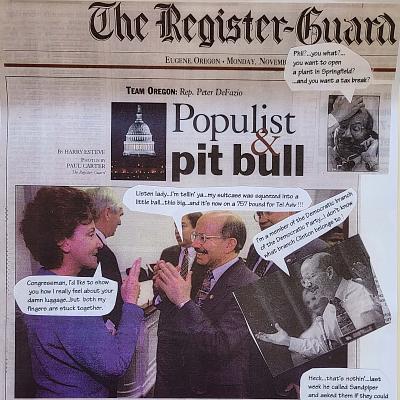
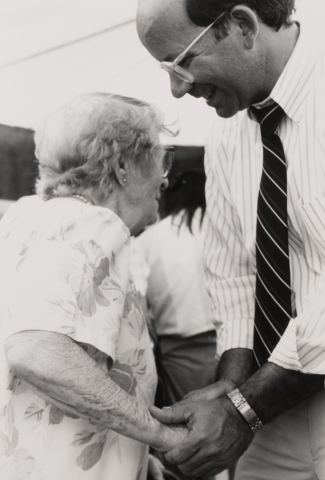
Following Weaver’s retirement, DeFazio won a hotly contested election to fill his mentor’s seat in the U.S. Congress. Adept at connecting with both bohemian and blue-collar constituents in the politically diverse 4th District, he would be re-elected by mostly comfortable margins throughout his career.
From 2019-2023 DeFazio chaired the influential House Transportation and Infrastructure Committee, which has jurisdiction over America's highways, railroads, aviation, water resources, ports and the U.S. Coast Guard. With Bernie Sanders and four other colleagues he founded the Congressional Progressive Caucus (CPC) in 1991; it has since grown to become the second-largest Democratic caucus in the House, with 97 members as of April 2026.
During his long congressional service DeFazio cast more than 20,000 votes and logged over six million miles traveling between Oregon and Washington, D.C.—the longest commute of any representative from the lower 48 states.
“Things don’t happen quickly or easily in Congress but I’m a legislator," he said. "I enjoyed being a legislator and I was good at it. I liked working on a wide range of issues and I was never bored. The hardest part was commuting eleven hours door-to-door from Eugene.”
His work made a big impact for Oregon. Rep. DeFazio protected more than 390,000 acres of wilderness in the state and secured it $1.3 billion in infrastructure funds. He played a key role in restoring federal recognition to the Coquille Tribe and expanding their reservation lands in southwestern Oregon. He's credited with helping to establish the National Organic Program in the 1990 Farm Bill. An advocate (and connoisseur) of the craft brewing industry, he also co-founded the House Small Brewers Association.

DeFazio is the longest serving congressional representative in Oregon's history. In tribute to his political role model, Wayne Morse, DeFazio was sometimes known as the "Tiger of the House."
A gifted orator, he gained a reputation for both eloquence and tenacity on the House floor, along with the ability to work across the aisle when bipartisan ground could be found on key issues. The satirical newspaper The Onion once published a story positing DeFazio as the sole surviving member of Congress after a literal battle royale between the representatives.
Throughout his career, he voted against—and refused to accept—every congressional pay raise while the federal government was in deficit spending. Instead, he contributed over $466,000 of his salary to fund 295 scholarships for Oregon community college students. He famously slept on a boat while staying in D.C. and continued to drive a decades-old Dodge Dart when back home in Oregon.
In 2022, DeFazio announced he would not seek another term in office. Since retiring, he has remained active running a political action committee and teaching courses in the University of Oregon's Robert D. Clark Honors College. Additionally he is a senior fellow at the Wayne Morse Center for Law and Politics. He resides in Springfield with his wife, Myrnie Daut and their much-loved dogs.
Acknowledgements
The work of preparing the Peter A. Defazio papers for public access has required the invaluable contributions of many people in UO Libraries and beyond:
- Manuscripts Curator Linda Long provided guidance on records retention and led the oral history project
- Assistant Director of Collections Management Austin Munsell facilitated the physical intake and storage of the collection
- Lead Processing Archivist Mahala Ruddell supervised the processing archivists who performed the detailed work to make the collection accessible
- Processing Archivists Matthew Fioti and Patrick McCall organized and described the collection, creating a finding aid to assist researchers
- Accessioning Archivist Alexa Goff facilitated description and online access to the oral history interviews
- Instruction and Outreach Archivist Emily Moore oversaw implementation of the DeFazio Research Award
- Archives Assistant Selena Brave created a pop-up exhibit to accompany the DeFazio Annual Lecture
- Professor Emeritus of English Paul Peppis conducted the oral history interviews
- Peter DeFazio, Kathy Dedrick, Travis Joseph and Associate Vice President Jason Younker were interview subjects
- Coquille Indian Tribe provided critical financial support to preserve the collection
Thanks to Vice Provost and University Librarian Alicia Salaz, Giustina Director of SCUA Sammie Morris, Senior Vice President for Federal Affairs Betsy Boyd, Professor Emerita and former University Librarian Deb Carver, and previous SCUA directors David de Lorenzo and James Fox for providing critical leadership over the course of the project.
Story by Jason Stone (Editorial Content and Communication Specialist, UO Libraries)
Photos from Peter A. DeFazio papers,1952-2022, bulk 1986-2022. Identifier: Coll 905. Part of the University of Oregon Libraries, Special Collections and University Archives Repository.