
With New Donation, Special Collections Goes Completely MAD

The latest addition to our holdings of historic comics and periodicals proves that Special Collections and University Archives has gone completely MAD!
Thanks to the generosity of donor Doug Gilford, the UO Libraries now owns what's surely one of the most comprehensive collections of MAD magazines and associated materials anywhere in the world.
Including a complete run, #1-550 (New York) and #1-45 (Burbank) of the regular issues, the collection also includes a large quantity of annuals and special editions, as well as paperbacks, hard and soft cover books and publications related to its art, contributors and publication history. Artifacts include a board game, posters and figurines.
"MAD never ran out of topics, and they never ran out of ways to duplicate themselves," Gilford said. "It's just a gold mine; dig in and you'll have a lot of fun."
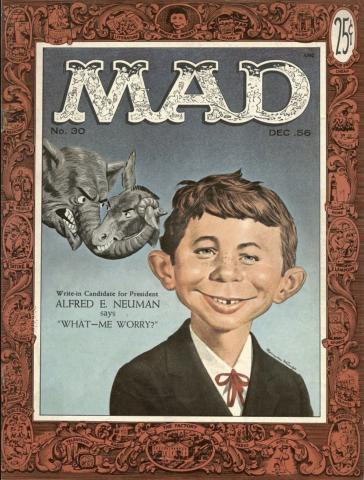
A History of MAD-ness
Created by artist-editor Harvey Kurtzman and launched as a comic book in 1952, the first issue of MAD promised readers "humor in a jugular vein." Switching over to a slick magazine format with issue #24, MAD would spend the next six decades skewering entertainment, politics and popular culture through a brash, satirical lens. Its roster of artists and writers—affectionately nicknamed "the Usual Gang of Idiots"—created a uniquely irreverent chronicle of American life through the postwar era, captivating successive generations of (mostly) youthful readers.
At its circulation peak in the mid-1970s, MAD entertained an audience of over two million. Its original, New York -based publishing run would span 65 years.
Although Kurtzman departed in 1956, the publication inspired loyalty from its creative talent and many award-winning artists remained on staff for decades, including Don Martin, Mort Drucker, Jack Davis, Sergio Aragonés and Dave Berg. In addition to its humorous influence, MAD launched graphically innovative features like Antonio Prohías' wordless, often puzzle-like strip, "Spy vs. Spy" and Al Jaffee's fold-in artwork on the back cover.
MAD's enduring inspiration has been cited by comics artists from Bill Griffith and Robert Crumb to Art Spiegelman and Dave Gibbons. Comedy legends including Jerry Seinfeld and Monty Python's Terry Gilliam have praised the magazine for helping to nurture their funny bones. And Roger Ebert gave it full credit for teaching him how to be a film critic.
Building the Collection
The Doug Gilford collection of Mad magazines traces its origins to 1975, when a ten-year-old Gilford encountered his first issue: it was #155 (December 1972), featuring a send-up of the hit movie, The Godfather. Amused and intrigued, he began purchasing new issues as soon as they hit the newsstands. Discovering an abundance of back issues available at Portland-area used bookstores—then digging up the rarer, early editions at comic book conventions—Gilford steadily filled the gaps in his collection. By the time of his high school graduation in 1983 he'd amassed a complete set of regular issues.
For the next several years, Gilford kept busy with college, marriage and running a business—but the advent of the World Wide Web rekindled his MAD passion. Combining his interest in the comics with his affinity for computers, he set about making digital scans from his collection and launched Doug Gilford's MAD Cover Site in 1997.
Despite an initial copyright warning from DC Comics, MAD's parent company, Gilford's website endured thanks to his noncommercial, informational approach. Supporting a vibrant community of fans, collectors and researchers, the site grew to include full indices of issue contents, including detailed credits for writers and artists.
"By the 2020s, as MAD magazine moved towards a reprint-focused publishing model and operations shifted from New York to Burbank, California, the context of the collection also changed," Gilford said.
Taking a deeper historical focus on the magazine and its talented creators, Gilford served as an associate producer on the feature documentary film When We Went MAD!: The Unauthorized History of Mad Magazine (2025). Now retired, he also began thinking about the next steps in life.
"Personal experiences with family aging and downsizing led me to consider legacy options for my collection. After researching university holdings, I chose the University of Oregon for its proximity to my home and its respected comics studies program," he said.
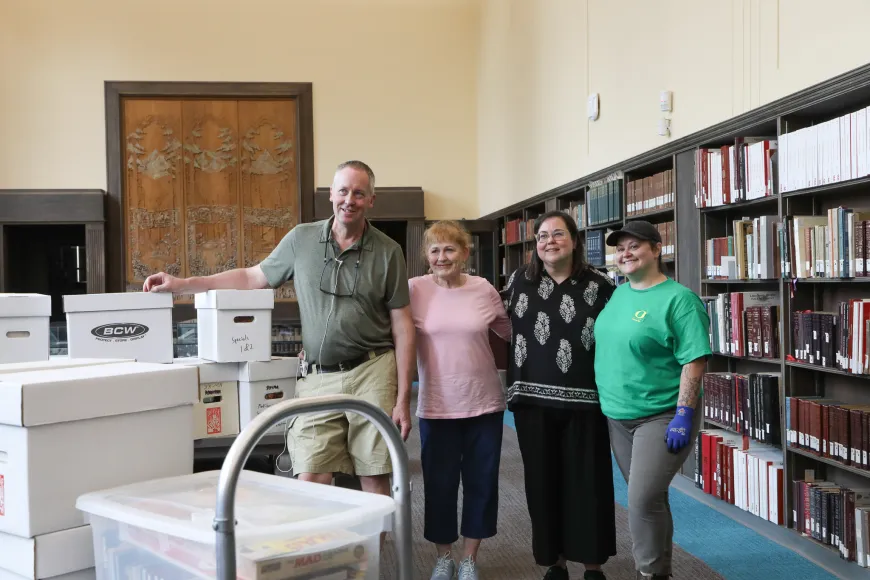
The handoff to the UO Libraries was completed on August 25, 2025 and the collection can now be accessed by researchers, students and library patrons.
"We are grateful to Doug Gilford for his foresight in considering the long-term preservation of this impressive collection, and for selecting UO Special Collections and University Archives as the recipient of it. It will be a pleasure to provide access to this collection to current and future generations of scholars, students, and the public, “ said Sammie Morris, the Giustina Director of Special Collections and University Archives. "I also want to express special thanks to Accessioning Archivist Alexa Goff for arranging this transfer and for the quick work done to make the collection discoverable."
Learn more about the Doug Gilford Collection of Mad Magazines in SCUA.